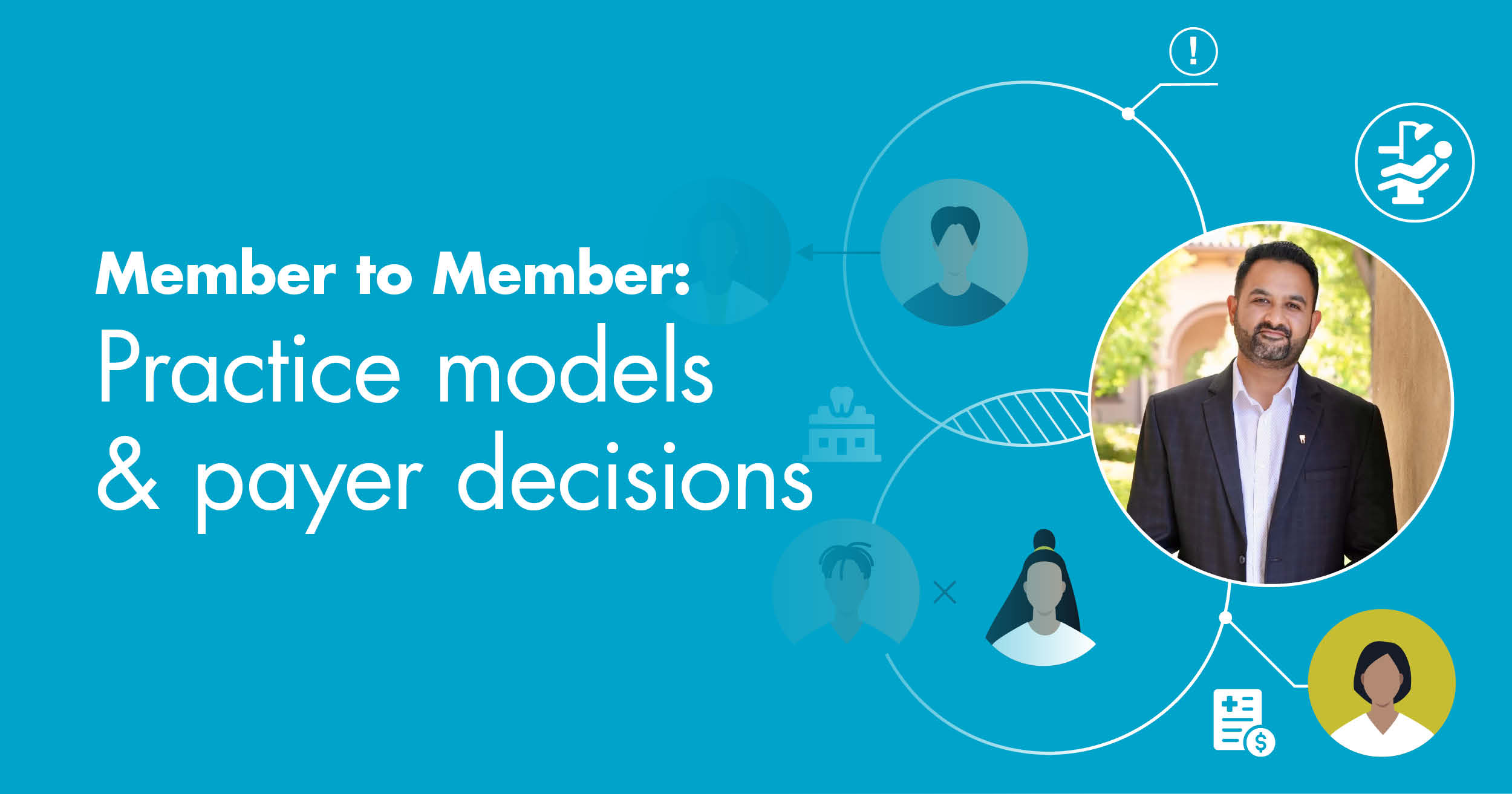
Abhi Thakkar, DDS, did not have his heart set on public health dentistry during or immediately after graduating from dental school. But he knew early on that he wanted to help people.
Growing up in India, his father, a businessman, was heavily involved in community outreach programs and would often take his son to events and activities.
“I really enjoyed those experiences, and I remember my father telling me that whatever career I choose, I should do something where I serve people because this is what brings real satisfaction in life,” Dr. Thakkar said.
Dentistry entered the picture when the young Thakkar saw how veneers not only closed the space between his sister’s front teeth—they changed her life.
“Her confidence really improved after that,” Thakkar said. “She smiled more and was much more comfortable socially.”
‘Dentistry brought all three things together for me’
Curiosity piqued, he started to closely observe his sister’s dentist and appreciated what he saw. “I realized the story was very different from what I expected. Most patients were coming in with pain, infection, broken teeth, dental emergencies … they walked in with pain but walked out relieved and grateful.”
Here was a profession that would allow him to solve problems, build long-term relationships with people and make a direct impact.
“I think dentistry brought all three things together for me,” Thakkar said. “You can serve people directly and still have that independence and problem-solving aspect that I was interested in.”
After completing training in India, he came to the U.S. and earned his Doctor of Dental Surgery from UCLA School of Dentistry, then went on to complete an advanced clinical training program in anesthetics and restorative dentistry in 2020.
Still, public health dentistry was not yet in the plans. “I was not one of the students who even went for public health lectures,” Thakkar said, smiling. “But I’m a public health dentist today,” he added.
Fewer jobs during pandemic opened a career path in dental public health
The Covid-19 pandemic—or, at least, the pandemic’s early impact on dental office operations and staffing—introduced Thakkar to public health dentistry. He graduated in 2019, just months before the pandemic started, to soon find that dental offices were not hiring or were closed to routine care per the state’s executive order.
With job opportunities limited, he started looking in California’s Central Valley, which he knew had a lot of federally qualified health centers. FQHCs are community-based health centers that qualify for certain Medicare and Medicaid reimbursements and serve all patients whether they can pay.
He found Camarena Health, an FQHC with locations in Madera, Merced and Fresno counties. It was open for emergency dental services, and there he launched his career in public health dentistry. He remains at Camarena Health today, but in an expanded role, having become the dental clinic’s director in 2022.
“That opportunity at a difficult time during COVID really shaped my career in ways that I did not expect at that time,” Thakkar said. “I was seeing all the physicians and nurse practitioners helping people and thought, how can I help as a dentist? What can I do? I’m in healthcare, too. So, this became my path in community dentistry and public health leadership, and for that I’m very grateful.”
Besides being a dentist and director at Camerena Health, Thakkar is chair of the Fresno City College Dental Hygiene and Dental Assisting Advisory Committee working to align curriculum with workforce needs.
And as a Champion Provider Fellow, he collaborates with local public health departments on policy changes needed to benefit communities. An adjunct clinical professor at Western University, College of Health Sciences, Thakkar also speaks to dental students statewide about early practice, answering their questions about potential career constraints of working in FQHCs.
“I explain to students that it can actually open up a lot of opportunities,” he said.
Balancing compassion, efficiency and access at the FQHC
Thakkar elaborates on the FQHC model embraced by Camarena Health.
“We’re built more on access and service—those are the two main goals and the big differentiator from the private practice,” he said.
FQHCs often serve patients whose needs are significant and ongoing. With Camarena’s integrated model, providers see individuals with dental, medical and behavioral health needs.
Many patients face barriers to care, such as language, work schedules, lack of reliable transportation and limited coverage, so when they do come in, they might have multiple needs at once.
“It’s not just their teeth, so you’re constantly balancing your compassion, efficiency, access, and quality at the same time,” Thakkar said. “You’re also balancing prevention, restorative care, same-day emergencies and appointments for patients who may not be able to return easily.”
“I’m very grateful when I can fix something significant for them,” he added. “That’s a big thing for us, being in healthcare.”
These aren’t negatives; they are challenges to solve skillfully
Thakkar stresses that these are some of the challenges of directing and working in an FQHC, but they are not negatives. They are problems to solve skillfully and with a dedicated team, even the sustainability challenge.
“Once you understand the system— workflows, access to care, insurance systems and your patient population, trust me, your work can become way more efficient,” Thakkar said. “We can improve processes and help more patients beyond the chairs that they’re sitting in.”
At Camarena Health, that looks like strengthening systems, rather than reacting to cost increases, which he suggests will continue to happen. He and his team have improved clinical workflows and inventory management, standardized supplies and expanded team-based care to ensure each employee is working at the top of their training.
“This allows the dentists to focus on the procedures that require us, while the care team supports preventive services, patient education and workflow efficiency,” Thakkar said.
They also track appointment no-shows, which are more common at FQHCs due to access issues.
“We want to dive deeper and understand why this person didn’t show up for their appointment because maybe we can fix it,” Thakkar said.
Providers and health educators use ‘teach-back’ strategy with patients
Some patients miss dental appointments due to anxiety, transportation issues or because they don’t understand their scheduled treatment and why it’s needed.
Patient education, specifically the teach-back method, is one strategy providers at Camarena Health use to better engage patients and teach them the importance of preventive care. The method works just like it sounds: the provider teaches something to the patient in understandable terms so that the patient can teach it back.
“I’ve been working with UC Berkeley and California Department of Public Health on some projects incorporating teach-back,” Thakkar said.
A team member will even draw on paper to help a patient understand something. The office uses simple language in the front and back offices.
When providers’ schedules are full, the center’s health educators will step in with the patient, providing 30-40 minutes of education that includes the use of models.
“We all know preventing disease and treating problems earlier is better for patients and more sustainable for the healthcare system as well, because absence of prevention can lead to costlier emergency treatment later,” Thakkar said. “Patient education is part of prevention.”
Open to all ‘regardless of any changes in the coverage or policy’
Camarena Health offers care coordination and sliding fee programs for eligible patients.
Most of the clinics’ patients are on Medi-Cal Dental, but the clinic also sees patients with private insurance. “We are open to all for care, guidance and treatment, regardless of any changes in the coverage or policy,” Thakkar said.
Asked how the uncertain future of long-term Medi-Cal Dental funding affects the clinics and patients, Thakkar puts the focus on patient access.
“For us, the larger concern is about how changes in the coverage eligibility may affect patients’ ability to access routine dental care,” he said. “That’s the larger concern because when patients lose coverage for preventive routine services, they will delay care, and those needs, again, can become urgent or emergency needs.”
He referred again to the clinics’ strong patient education practices as well as the need to be proactive: assisting patients with insurance, enrollment, eligibility and navigation. “We want to really use the triage system to ensure that our patients with urgent needs are seen quickly,” Thakkar said.
(Related: Read “Medi-Cal Dental funding protected for another year in 2026-27 state budget.”)
‘Without my team, I don’t think I can do anything’
Thakkar and his chief of operations, director of operations, front managers and back managers work together to review, strategize and implement changes in operations and staffing.
“It’s not me just saying, ‘here’s my word as a dentist,’” he said. “It’s teamwork. Without my team, I don’t think I can do anything.”
Staff retention is a major focus, as is mentorship of new dentists fresh out of dental school. He provides chairside assistance but emphasizes skill-building and wants them to develop their confidence.
“I’m not just throwing a new dentist to a patient,” Thakkar said. “If they have a case that they want to discuss, I am there for them, but I tell them, ‘If you want confidence, I’ll be chairside with you, and we’ll get this thing done together.’ I really think my new graduates love our health center because of this. Because they understand that I too have been there.”
Thakkar knows that building a strong dental team that can balance compassion, efficiency and access takes work—and that keeping that team takes more work.
“We provide training and a healthy environment for our employees. With that, success only goes up,” Thakkar said. “But, more than that, I’m proud of what we do at Camarena because we’re not just saying we want to do great for our patients, but also for our employees. If they’re happy, they might think of us as a family, and that is the ultimate compliment.”
More on FQHCs and dentist career paths in public health dentistry
In “Alternative Pathways in Dentistry: Working at Federally Qualified Health Centers” published in the Journal of the California Dental Association, the authors present an overview of FQHCs and discuss dentists’ roles within them to address health care disparities. The article is part of a Journal collection that discusses dentistry careers outside of traditional practice.
Also see the American Association of Public Health Dentistry.
More ahead in CDA’s series about members’ diverse practice models
Read articles 1-4 in CDA’s continuing series about member-dentists who have pursued diverse practice models, approaches to working with dental plans and patient care financing options.
- California dentist rises to the challenge of being a new practice owner while out of network with Delta Dental
- House calls and a custom-built brick-and-mortar: One California dentist’s uncommon path to practice ownership
- “Blindsided: Practice owner details the pitfalls of dental plan leased networks”
- The multi-practice model: Two California dentists credit resiliency, risk-taking and comprehensive business skills for success