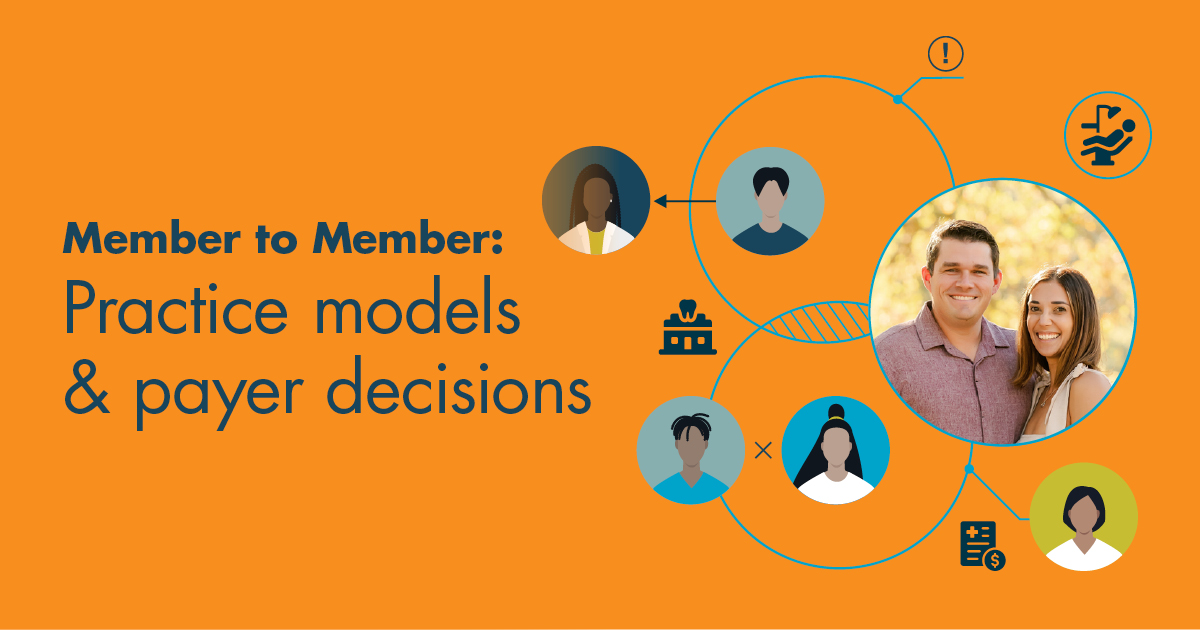
They met in organic chemistry class in their second year in college, got into UCLA School of Dentistry at the same time, started and completed their residencies in general practice (she) and orthodontics (he) in Virginia together, then moved back to California and started their careers, eventually purchasing two dental practices just four and eight months before the COVID-19 pandemic disrupted lives and healthcare delivery. They managed their individual practices through the pandemic and later purchased two more.
Somewhere in there, before becoming practice owners, the two got married. That, in a nutshell, is the career path of Drs. Matthew Sandretti and Stephanie Sandretti, or, more fairly, two individual paths closely aligned.
Both, who are now in their 12th year of practicing dentistry, agree that taking risks has paid off, in part because of their own resilience. But they also credit the profession—especially dentists with many years in practice—for helping them with challenging transitions.
Moving from Virginia, where they didn’t have any connections in dentistry, back to California, where they wanted to settle and start their careers, was an early challenge. Transitioning from associate and part time work, including at a dental service organization, to practice owner was another, and growing those practices during the pandemic yet another. All the while, the Sandrettis, who are parents of two young children, continued—and continue today—to make time for wellness, family, personal interests and skill-building.
Here, Matthew Sandretti, DDS, and Stephanie Sandretti, DDS, share how they navigated these career stages by relying on themselves, each other and the connections that come from organized dentistry. They also offer lots of advice for early career dentists.
After completing your residencies, you returned to California to start your careers. How did you make that happen?
Stephanie Sandretti: Looking for California jobs while living on the East Coast was tough. We didn’t have any dental connections here.
As a student, I was involved in the American Student Dental Association. At the ADA meeting in 2012, I had a conversation with the owner of an orthodontics practice in Sacramento County. I told him that Matt and I would love to return to the area after completing our residencies and that Matt would be applying to orthodontics offices. He replied, “Here’s my card. Call me when he’s ready for a job.”
I called him two years later and reminded him that we met at the ADA annual meeting when I was still a student. I shared that my now husband and I were ready to come back to Sacramento and asked if he had anything. Within a couple of months, Matt was working part time at this dentist’s ortho office in Elk Grove. Around the same time, I was offered part-time work at a private practice.
It’s just another just crazy connection that came from organized dentistry. Having and making those connections is important always but certainly when starting out.
Did you supplement your part-time income with other dentistry work?
Stephanie Sandretti: We both worked for a dental service organization two or three days a week in addition to working the two days in private practice. It was the easiest two-day-a-week job to find.
How was your experience working for the DSO and how long did you stay?
Matthew Sandretti: Being a specialist at a DSO is very different, so overall I had a very positive experience. They left me alone and didn’t meddle in my treatment planning. I was producing well for them, so they were happy and gave me whatever I asked for.
During this time, I also purchased a practice that was very busy but had a lot of challenges. Work experience at the DSO really sped up my development in terms of what to do when the case is not going well. I learned some problem-solving stuff real fast, so I am grateful for that.
Stephanie Sandretti: Matt was steady, but I lasted 10 months. I ended up working for a variety of different private practices, two or three at the same time, for about four years until I decided to buy my own practice.
How and when did each of you buy your first practice? Did you have any major challenges?
Matthew Sandretti: After four years with the orthodontist who gave me my first job, I purchased the practice from him in summer of 2019. Soon after, I fully transitioned out of the DSO. But he is still working part time—we essentially swapped roles overnight. He won’t give dentistry up completely!
I only had a few more scheduled days at the DSO before COVID hit, so COVID sent us for a loop. Stephanie and I bought our practices at about the worst time you ever could. I was eight months into my practice ownership, and she was four months into hers.
Stephanie Sandretti: I purchased my first practice, which had two locations—in Sacramento and Roseville. We were small and growing, and it was a great introduction for business ownership, until COVID hit. Then I had to really learn how to be a business owner, overnight with only four months under my belt.
You then acquired a second practice where you had been an associate?
Stephanie Sandretti: Yes, I’d been an associate at the Vintage Park location in Sacramento for four years and had told the owner that I would love to buy her practice. I saw so much opportunity with us as partners, but she just wasn’t ready at the time, and I ended up leaving because I was kind of itchy to buy something.
But, she called me in mid-2021, a little less than two years after I’d purchased the practice with two locations—I called them my twins—and said, “I really think I’m ready to sell, and I want to sell it to you. You’re the only one I want to take over.” It worked out well, as my other Sacramento location was only about three miles away, so I just merged them.
She had a great practice, but it was old-school everything. Within a month, we were cloud-based and brought in scanning, etc. I sent that team for a loop. Inside of three years, we went from paper charts to a 3D printer, two mills, two scanners, ortho, IV sedation, CBCT.
The selling practice owner said she wanted to sell only to you. Why do you think that was?
Stephanie Sandretti: I stayed on great terms with her. I helped her through the COVID pandemic, and I think she was grateful for that.
I always stayed on good terms with all the practices I worked at. I never burned a bridge. I stayed in touch with everybody. I try to tell all my mentees to never leave a practice on bad terms.
If you’re not happy, always give the owner notice, give them time and do right by your patients. Leave on good terms because dentistry is the smallest world ever. Everyone knows everyone by one degree of separation, and you just never know when you’re going to need that person again or want a referral.
You then purchased a fourth practice together. How does it differ from the others?
Stephanie Sandretti: We bought an existing practice with dentists who are four to six years out from retirement, and they were vehemently not wanting to sell to a DSO. A consultant connected us with them, and we saw an opportunity to have a rental-property practice. We have a team and managers who run it. It’s in Lake County. We go up once a month and have nearly daily communication with them about a variety of things.
I call this practice my dream practice. It’s everything I’ve ever wanted to build in a practice, and I’m now trying to copy that into my locations in Sacramento.
Do you have separate corporations for each of the practices, or do you have them under one global?
Stephanie Sandretti: The S corporations for the two Smile Designs are under one because I bought them together. The Lake County practice has its own, and we have an LLC for it because we bought the building. We’ve talked to our attorney and CPA about whether we should have a parent company with the umbrella. They said we could, but that’s another tax return, so we decided to keep them separate.
Do you have a high percentage of uninsured patients in your practices? Do you offer discount programs?
Matthew Sandretti: Ortho’s a little bit different. Essentially, everybody does in-house financing, so, we just break up the cost over months. Ortho insurance is mediocre at best. Most of my patients are expected to pay for orthodontics, so their dental insurance works more like a gift card to be used toward orthodontic treatment.
Most people will take advantage of the in-house financing, on which we don’t charge interest. We’ve looked at some third-party companies that do charge interest, and they can spread it out over longer periods. We haven’t really delved into that, but some people are successful with that model.
Stephanie Sandretti: In my offices in Sacramento and Roseville, we offer an in-house membership plan, so the patient pays two, three or four times a year. They pay one fee, and then they’ll get a discount on most of the treatment provided in-house. Some patients who previously bought individual dental plans dropped them and started doing our in-house plan. That’s been very successful.
Lots of offices are doing this. We don’t use a third-party company—instead, we run it ourselves. Our software coordinates with the program and it works well. We are in network with 40 or 50 pretty good plans and make sure our patients know this.
What are the advantages and disadvantages of owning multiple practices?
Stephanie Sandretti: Optimization. What’s neat about owning multiple practices, which newer grads don’t necessarily see, is the economy of scale.
For example, we get DSO pricing on everything. Maybe not exactly what the DSOs are paying, but we’re paying a lot less than private practices pay. We pay 40% less on supplies, and because of our volume I just negotiated our bone graft material down to $35 a vial after paying $70 last year. So even though we’re not a DSO, suppliers are recognizing us as a small to mid-sized group. That’s been helping a lot.
As for disadvantages, we’ve had many a night where we’ve said let’s just sell everything.
What motivates you to continue when you have those ‘let’s sell everything’ moments?
Matthew Sandretti: You have to intentionally schedule times for your personal interests and growth. For a while I neglected to invest in C.E. topics that really stimulated me and made me excited. Because of my renewed investment, I am doing nasal alveolar molding on infants with cleft palates and have been for about a year now.
Stephanie Sandretti: You can’t get stagnant. It harms your team, energy and morale. OK, so my teams can get a little annoyed whenever I say we’re doing something new! But I wouldn’t have it any other way.
We are more successful because we’ve had a true partner academically, professionally and socially through everything. And we took bigger risks than many could or would because we had two good incomes.
But we’ve also always shared the philosophy that nobody can take our dental license and skills away from us. If we are struggling, Matt can easily get a job with a pediatric practice on Saturdays, and I can work at a DSO on the weekend or Fridays. There’s always a need for dentistry.
And resiliency has to be there because you’re going to make so many mistakes. You will say the wrong thing, someone will quit because of something you did or didn’t do, and you won’t always know why people do what they do. You cannot make everybody happy. The sooner you learn to let that stuff just go, the better. I decided not to be stressed anymore. It is a choice. Everybody feels stress, everybody feels pressure, but you get to choose how you respond to it.
What were some of the most important lessons that you learned early in your practice?
Stephanie Sandretti: I found it great to work at a lot of different practices and types of practices because you don’t really know what you want until you’ve experienced it. I tell people all the time to do the DSO thing. Try it, and then do the private practice thing, and also work at a federally qualified health center because you can’t be sure what kind of dentistry you want to do until you are in it.
Also, the debt was a huge burden, but once I owned, I had more control over my taxes and ability to write things off. That was something that we learned quickly. The practice debt is also hard, but it will eventually be paid off, and with the right foundations the businesses aren’t going to go under.
What advice would you give early career dentists about having a multi-practice structure similar to what you’ve built?
Stephanie Sandretti: My biggest piece of advice is that if you’re thinking about buying a practice, you must be able to do every single job in that practice. You have to be able to do the insurance coordinator’s job, the billing and the HR, and you need to know how to run payroll.
I think that’s a big part of what makes my practices successful. I understand all the nuances of insurance, and I understand all the billing. I can read an EOB in two seconds, and I can look at a ledger and find the problem in five seconds.
A lot of business owners think that they can rely on their team for everything. Not that my team isn’t great at what they do. But here’s a situation: four months after I bought my practices in 2019, I was shut down, and all my staff was gone. I was dead in the water, and I had all these claims sitting here, and checks coming in, so I had better drive to the office to get my checks, open EOBs and figure out how to read them, post payments and bill patients.
COVID was terrible, and I never want to go through that again, but as I said before, it was my crash course in business ownership. Dentistry is the easiest part for graduates. Dental school teaches you all of that, but you have to be able to do good dentistry and run a team of people. If your office manager leaves tomorrow and you don’t know how to do that job, until you find a new employee you will not be able to step in and take over those duties to keep your money flowing and run your team and practice.
Dentists need to sit in every single one of those places. I’ll answer the phone, schedule an appointment, bill some, and send a claim. I realize that’s not the norm in every practice, but maybe it should be?
Do you have or make time to volunteer?
Stephanie Sandretti: A lot of my volunteering is international, so I still have a hand in the dental missions with the Honduras Dental Care Foundation that I started back in dental school in 2010. I still run that, and we’ve had 21 or 22 groups, maybe more, since 2010. Obviously, during COVID we had to stop. And with Zika virus there, we had to stop, but we just sent a mission last year. The doctor I was working with is trying to bring it into El Salvador, too, so I do some fundraising and get supplies for them.
It’s harder for us currently because our kids are so young, but we used to volunteer at all the CDA Cares. I’m also contracted with the Veterans Administration, so they send me cases, and I take care of them.
Once the kids get a little older, we’ll be able to get back to doing more in the community. But to balance our time, we ensure we always have something to look forward to. We block our schedules a year in advance, whether for a week or long weekend. To avoid burnout, you need to be intentional about scheduling your time. It’s not new advice, but it’s good advice!
More ahead in CDA’s series about members’ diverse practice models
Read articles 1-3 in CDA’s continuing series about member-dentists who have pursued diverse practice models, approaches to working with dental plans and patient care financing options.
- California dentist rises to the challenge of being a new practice owner while out of network with Delta Dental
- House calls and a custom-built brick-and-mortar: One California dentist’s uncommon path to practice ownership
- “Blindsided: Practice owner details the pitfalls of dental plan leased networks”
More practice management insights
In a CDA Journal collection published in 2023, five authors share their knowledge and expertise on many aspects of dental practice management, including annual planning, dental benefit contracts, practice valuation during transitions and workplace culture. Read Practice Management Insights.