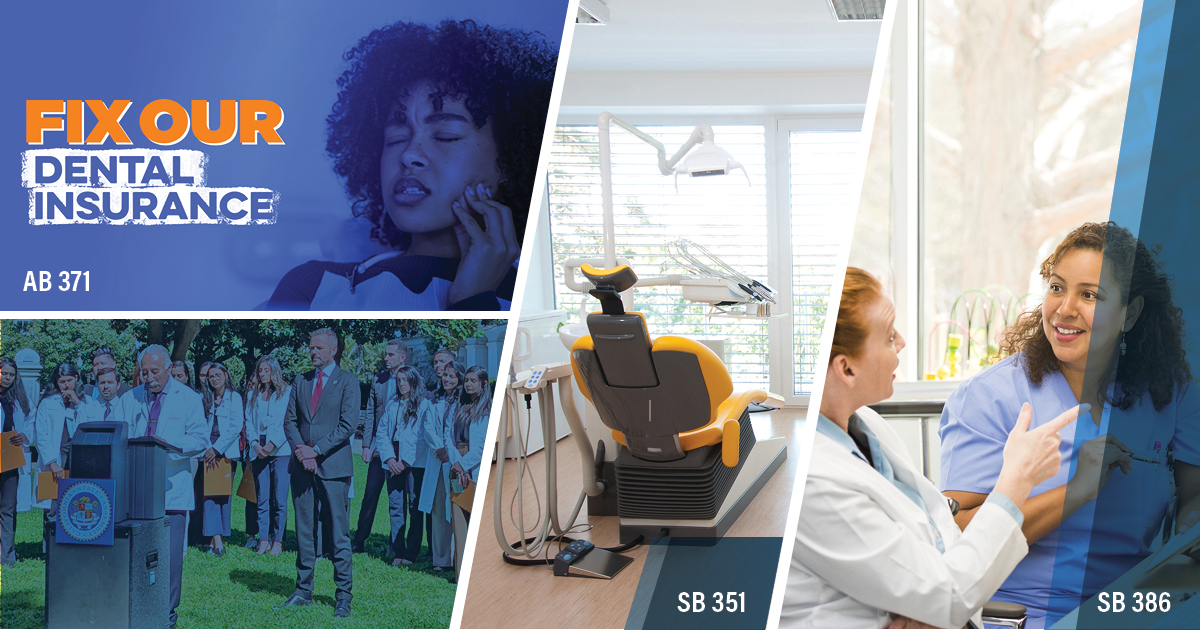
CDA accomplished and advanced major advocacy priorities in 2025, including two sponsored bills that passed easily through the state Legislature and received Gov. Gavin Newsom’s signature in October. The bills, SB 386 and SB 351, tackle very different issues on a shared theme: unfair or undue practices that interfere with dentists’ clinical decision-making and the dental office’s time and focus on patients.
SB 386, which protects dentists from dental plans’ predatory use of virtual credit cards, will provide relief starting April 1, 2026.
SB 351, which ensures dentists’ clinical judgment comes first — above private equity interests — will take effect Jan. 1, 2026.
CDA advanced two additional sponsored bills that will continue into next year. AB 371 would require all dental plans to comply with patient assignment of benefit requests among other provisions to reduce patients’ travel and wait times for appointments. While AB 371 was held earlier this year, Assemblymember Matt Haney will reintroduce a new version in 2026.
To help advance AB 371 in the Legislature, CDA amplified its “Fix Our Dental Insurance” campaign (fixourdentalinsurance.com) with targeted digital advertising and grassroots activities.
The second, AB 873, would reduce the statutory barriers unlicensed dental assistants face in completing the eight-hour infection control training. These barriers are exacerbating the challenges dental practices have with hiring and retaining staff. This bill advanced to the state Senate.
Dr. Max Martinez credits CDA members for their role in bills’ success
CDA President Max Martinez, DDS, said, “We can be proud of what we accomplished together this year. ‘We’ is not just CDA’s legislative advocacy team but also the many CDA members and dental professionals who phoned and emailed their legislators, shared personal stories about frustrations with dental plans or participated in our advocacy days at the state Capitol. Our work continues, but we can celebrate our success and come back next year to push for more dental plan reform and fight for budget actions that preserve the substantial Medi-Cal Dental improvements made over the years.”
Dr. Martinez is referring to state budget funding through Proposition 56, the voter-approved ballot measure in 2016. Prop 56 funding has led to a 34% increase in Medi-Cal Dental providers and 37% increase in new dental office visits by Medi-Cal patients since 2020, according to the most current data.
The governor’s revised budget released in May called for Proposition 56 dental funding to be redirected to the budget deficit effective July, but CDA quickly mobilized a campaign to prevent the immediate cuts. Roughly 745 dentists and other professionals joined CDA’s call to action, making 1,475 contacts with legislative offices and urging them to respect the will of voters and “stop the governor from robbing Medi-Cal Dental funding.” The Legislature rejected the governor’s proposal and through a final budget agreement preserved dental funding through July 1, 2026.
No more default fee: Dentists will have clear choices when dealing with VCCs
SB 386, the latest achievement in CDA’s ongoing advocacy for comprehensive dental plan reform, will do the following when it takes effect April 1:
- Dental plans cannot use any payment method that includes a fee as the default payment method when reimbursing dentists the amount they are owed for contracted services.
- Dental plans must provide a clear and easy way for dentists to opt in and out of receiving payment by virtual credit cards.
- Dental plans must notify dentists of alternative payment methods, how to select a method and any fees associated with each method.
The ability to opt out of VCC payments ensures dentists receive the full payment for dental services they provide, as VCC companies can charge fees up to 10% per transaction. Many dentists have also reported being opted back in to VCC payments even after opting out.
“Getting SB 386 signed into law is a huge victory for California dentists,” Martinez wrote when the governor signed the bill in October. “No more must dental office staff make the difficult ‘choice’ of either spending hours repeatedly opting out of VCC payments or accepting the VCC payments with high fees just to keep the practice running most efficiently.”
Read more in the CDA article about the new protections from virtual credit cards.
Dentists’ clinical judgement comes before private equity interests
Physicians’ and dentists’ concerns with private equity practices have received more attention nationally with firms and hedge funds exerting controls that allow corporate interests to influence clinical decision-making.
“As private equity interests invest in dental practices, we need updated laws that explicitly address current circumstances to ensure that dentists’ autonomy and patients’ needs are protected,” Martinez said. “We got that law!”
When CDA-sponsored SB 351 takes effect Jan. 1, it will bar private equity firms from influencing clinical practice by:
- Imposing patient quotas that pressure dentists to prioritize profit over necessary care.
- Implementing restrictions on the amount of time a dentist can spend with each patient, limiting their ability to provide thorough care.
- Interfering with a dentist’s ability to select the most appropriate dental supplies and equipment for patient care.
- Controlling patient treatment plans by restricting the types of procedures a dentist can offer.
- Dictating which diagnostic tests a dentist can order for a patient.
- Interfering in referral decisions.
Get the full details in the CDA article about how the law protects dentists’ autonomy.
Improving dental care for vulnerable populations
Dentists, dental schools and students and patients with special needs received more good news this year:
- New law (AB 341) created a demonstration project to improve dental care for developmentally disabled patients.
- DDS-ASPIRE program at UCSF received a $1.8 million grant to recruit and train dentists to treat underserved populations.
Dental plan reform advocacy will continue
CDA will continue its dental plan reform as part of its overall legislative strategy in 2026. For updates, watch the CDA newsroom and Major Issues & Priorities page,sign up to receive CDA’s weekly member newsletter, Inside California Dentistry, and visit the Dental Plan Action Center.