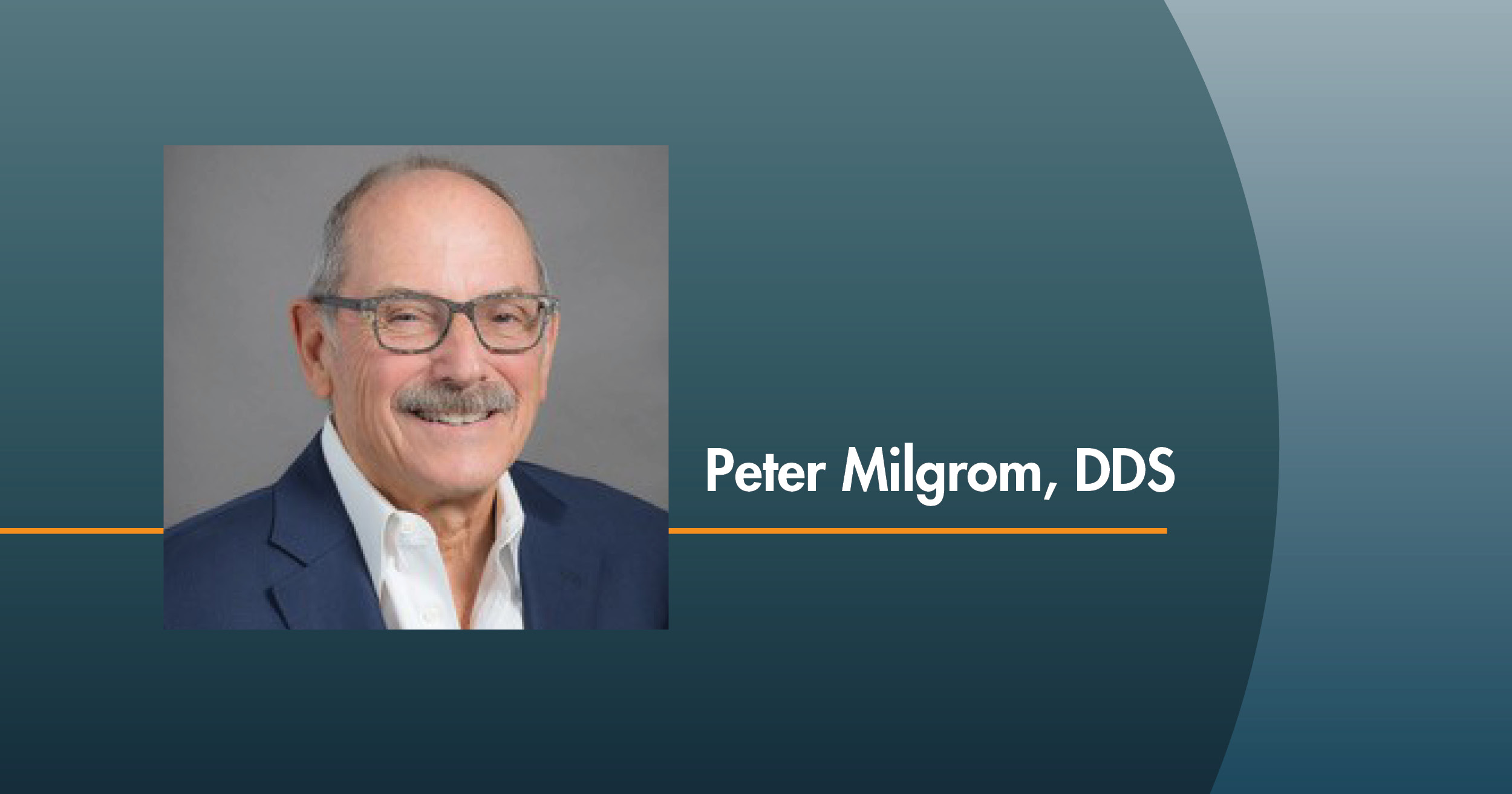
Economic and health policy decisions made in Washington often feel a long way from the everyday dental practice. But those policies shape many parts of dentistry – from access to care to how that care is delivered. The CDA Journal collection “No Practice Is an Island: Impacts of Federal Economic and Health Policies on Dentistry and Oral Health” explores these connections from several important angles. CDA asked guest editor Peter Milgrom, DDS, how the collection came together and what he hopes readers will take away from the articles.
What motivated you to accept our invitation to guest edit this collection?
This question is easy. The preamble to the ADA Principles of Ethics and Code of Conduct says: “The dental profession holds a special position of trust within society. As a consequence, society affords the profession certain privileges that are not available to members of the public at large. In return, the profession makes a commitment to society that its members will adhere to high ethical standards of conduct.”
As a long-time member of the profession, I feel strongly that I have the obligation to share my skills because a well-informed professional community can best serve its patients and the larger society. Fulfilling this commitment sometimes means a lot of extra work, as was the case with the Journal collection, but I feel well-compensated having produced a great collection with thoughtful, skilled collaborators.
Why is this an important moment to examine how federal policies affect dental practice and oral health?
This is an unsettling time, and the disruption impacted me personally and touched professionals around me and the community at large. It was time to share expertise. Few predicted the erratic and poorly thought-out policy changes and back-and-forth in the courts. I felt it was an important moment – a teachable moment – to think beyond one’s circumscribed, protected personal world.
As I craft my responses to these questions, I am teaching a hands-on continuing education course on preventive dentistry and minimally invasive care in Majuro, the capital of the Republic of the Marshall Islands. The island dentists have limited access to new technology and information, and dental disease is rampant. At its highest point, Majuro is 10 feet above the ocean and inevitably will be swamped and made uninhabitable by climate change. Building sea walls won’t solve the problem. I think the dental profession faces a similar existential crisis. Neither the crisis in climate nor that facing the dental profession is a joke.
When you were recruiting authors for the collection of articles, what perspectives or expertise were you hoping to gather?
I leaned on more than a half-century of relationships with mentees, co-workers and contacts in academia, public health and industry to recruit authors. I sought to broaden the discussion and include individuals who voted for the current regime and those who did not. I wanted individuals who were knowledgeable and could accurately assess the changes but also wise enough to be able to put aside self-interest.
How did you decide which policy issues were most critical to highlight in the collection given the range of federal policies that influence dentistry and oral health care?
I took the “no practice is an island” charge seriously. I’m motivated by the imperative to improve access to care and good oral health for everyone. I took a broad-brush approach because the disruptive policies ranged across sectors of the profession. At the same time, I wanted to have the authors address pocketbook issues that impact the individual dentist.
I graduated from UCSF School of Dentistry in 1972 and, since then, I’ve worked as a clinician-scholar where I’ve cared for patients and conducted research. I especially wanted to highlight the importance of research and research funding for patient care and the future of the profession, especially any impacts on California’s educational institutions. I thank my colleague Dr. Rena D’Souza for her friendship and willingness to contribute.
Did any viewpoints surprise you during the editorial process – either because they emerged as especially important or because they challenged common assumptions in the field?
One area of this job rattled me, and another confirmed some of my own biases.
The first was the unwillingness of leading educators to address the dramatic impacts of changing federal policies on the university and the dental clinics that are essential to our schools and colleagues of dentistry. They were afraid, and their silence scared me. Engendering fear was purposeful among some federal policymakers. I thank Dr. Dean Mark Wolff and his colleagues for their insights.
The second surprise was the reviewers’ reactions to the paper on serving rural communities. The predictable assertions of second-class care and bias reminded me of a time when members of a group practice in Los Angeles were not allowed to join the dental society or ADA.
Why were the members not allowed to join?
Early on, dental societies interpreted group practice as a business and held that only individuals could practice dentistry as a profession. This was especially common in the 1950s. It was long held that corporations could not practice dentistry. The profession used combinations of laws and ethical codes to enforce their view. I also think this was a carryover from post World War II Red Scare politics where group-practice dentists were seen as socialists (or communists), and some certainly were. This was told to me by the late Dr. Max Schoen, a former dean of the UCLA dental school who was part of the group practice as a young man.
As for the profession’s current climate, dramatic changes are happening in health care delivery and financing, and I salute the authors of the rural dental practice article, Dr. Jonny Norris and Dr. Mike Shirtcliff, for sharing their experience, warts and all. I was glad to co-author the paper because I’ve worked with both of them and felt I could help tell their story.
What do you hope readers – particularly practicing dentists and oral health professionals – take away from this collection about the relationship between policy decisions and everyday dental practice?
The small size of the dentistry profession, which includes dental students, practitioners, public health workers, insurers, educators and manufacturers, belies the importance of good oral health to our communities and nation. Ignorance, self-interest and passivity do not serve us well. I hope each reader learns – like my Marshallese friends – that our “island” needs to actively push back against government policies that are ill-planned and destructive. If not, they could be swamped.
Any final thoughts?
I hope that my work on this collection results in a lively discussion. Nothing is more important. I’m grateful for this opportunity to fulfill my ethical obligation and to give back to the profession and the individuals it serves.
Peter Milgrom, DDS, is emeritus professor of oral health sciences at the University of Washington, Seattle.
More collection articles
Impacts of federal policies on:
Dentists’ Income: How Recession-Proof is the Dental Sector?
Dental Materials Market and Biomaterials
Dental School Care Centers and Dental Student Education
Impacts of Medicaid cuts on:
Emergency Department Utilization