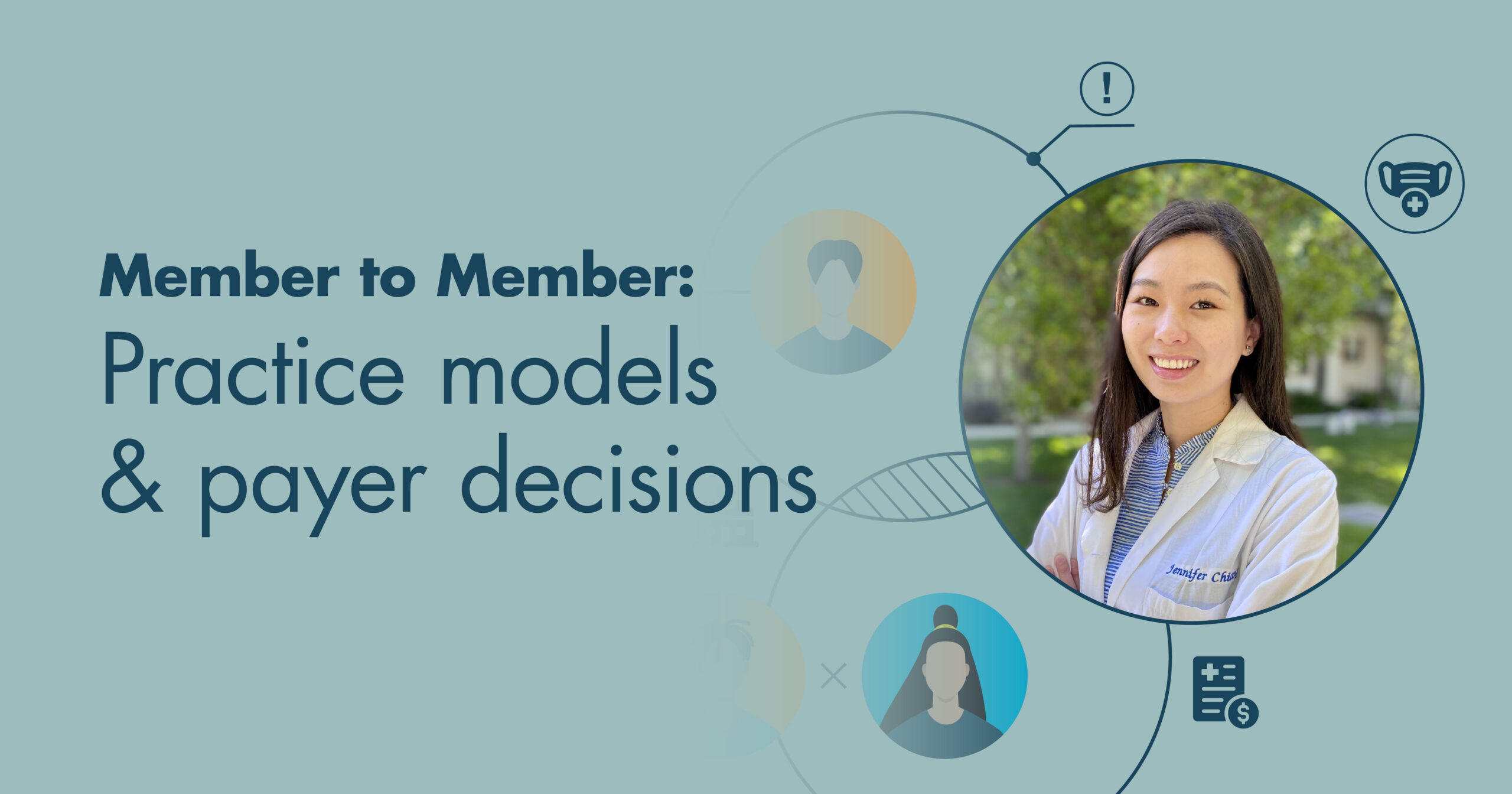
Jennifer Chiang, DDS, needed to first work as an associate dentist to know what she really wanted for her career: to run a practice that fully supported her vision of patient care. “I don’t like doing volume dentistry,” she says. “We focus on prevention and the patient relationship—I think that’s the best part of dentistry.”
She met challenges early in practice ownership, chief among them the start of the COVID-19 pandemic, that provided crash courses in business management and accelerated her growth as an employer.
Later she determined that exiting contracts with all the dental benefit plans, especially the larger ones, was necessary for the long-term sustainability of her practice.
Dr. Chiang shares her story here with other dentists, especially early career dentists and dentists who are considering practice ownership. Sharing her experience is one way of “giving back” and an acknowledgment of the expert guidance she received along the way.
“I don’t think I’m alone,” Chiang said. “I think other dentists are facing a lot of these same challenges. This is the modern dental practice now. But there is good guidance for us out there.”
Practice ownership was an opportunity ‘to do things a little differently’
Chiang was seeing patients two days a week in a space she rented from another dentist in Sunnyvale, a city in the San Francisco Bay Area. She was in her ninth year of practicing dentistry and thinking about practice ownership. How might it compare with space-sharing and associateships?
She credits the owner-dentist—referred to in this article as “Dr. B”—for helping her see an opportunity.
“Dr. B. was amazing and did a lot with education, helping patients understand the oral-systemic connection,” Chiang said. “These were things that I really enjoyed myself, but it was hard to implement those concepts at the same level in my associateships. I learned I liked seeing my own patients, and I thought in my own practice I could do things a little differently—be more prevention-focused.”
When Dr. B decided to retire in 2019, Chiang said she didn’t feel ready to take over his practice because he was fully fee-for-service, so in August 2019 she signed a lease on space and brought her patient load over.
Then came the pandemic—the first challenge she navigated as a new owner not seven months into her lease, and it would lead her to exit all the plans, after all, to sustain the practice. “The ultimate irony,” she calls it.
“I sometimes joke with my team that I’m a COVID dentist. I’m a little different,” Chiang said with a laugh. “But I never once thought, ‘I don’t want to do this.’ I had only two choices. I was either going to do it, or I wasn’t going to have a practice.”
Getting through COVID ‘by the skin of our teeth’
Chiang said she and her team got through COVID “by the skin of our teeth.”
She couldn’t qualify for grants that assisted other small businesses because she didn’t yet have the financial track record. She was “fighting tooth and nail,” like all dentists during this time, for N-95 masks and other supplies and banding together with peers and her local dental society to figure out how to pay for the supplies when they were available.
“We were complying with more stringent infection control measures, but at the same time, the individual cost of supplies increased drastically to where we were deciding between buying extra plastic gowns or taking on the cost of laundry,” Chiang recalled.
Complicating matters, several months into the pandemic, Chiang learned that the building in which her office was leased would be redeveloped, requiring her to either relocate her practice to another unit in the building, possibly repeatedly, or to a different address.
Going into the lease, Chiang knew the owners would develop eventually. “A lot of time was spent on the lease negotiations,” she said. She had wanted to ensure the cost of moving between units would be covered and that they had similar spacing and operatory allotments.
Nevertheless, the seven-on-seven-year lease she’d signed did not offer the protection she thought it had. On top of that, the city had a housing crisis and was under pressure to approve housing projects.
Navigating lease terms was not something she learned in dental school
Chiang said steering a practice through a pandemic and navigating lease terms, including meetings with lawyers, was not something she learned how to do in dental school.
“When you’re the business owner, you are the main clinical engine, but you might also be dealing with issues that you’ve never dealt with before. There are a lot of things happening … a lot of forces acting on dentistry, including pressure to own our own practices. But when push comes to shove, you need to figure out how to make it all work.”
For Chiang, making it work ultimately meant purchasing a practice rather than repeatedly moving during a renovation or taking on a build-out. She credits a friend who’d recently finished a custom build for cautioning her about the expense.
“She gave me something to chew on. She said that what you think will take six months will probably take a year with all the change orders. She said, expect to pay double for permits. Keep in mind you’ll go through a full eight-hour clinical day, then come back and have to make these big decisions with the contractors, she warned. She suggested I consider the benefit of moving right into a practice if it’s close to what I want.”
Chiang purchased the practice—also in Sunnyvale—and merged her two practices to stabilize her situation with the seven-year lease. She brought her patients over to the new practice and hired an associate to take some of the patient load.
Then she implemented her biggest change yet: going out of network with all dental plans and becoming a fully fee-for-service practice.
‘I couldn’t make the math work by staying in network’
“Back when I turned down purchasing Dr. B’s practice, I wasn’t at the point where being out of network with the dental plans made sense to me,” Chiang conceded. “A fully fee-for-service practice felt too different from what I was accustomed to growing up. I thought you had to see a network dentist. But as a practice owner today, under all these circumstances, I saw I couldn’t make the math work by staying in network. For the practice’s long-term sustainability, I had to do something different.”
Chiang said Delta Dental’s contractual amendments announced in 2022, which led CDA to take legal action, was the event that “tipped the scale.” Over Thanksgiving break, after receiving Delta Dental’s letter, Chiang said she looked over the procedure codes and realized that reimbursement would drop for all the codes she used.
“We didn’t have enough other patients with other coverage to buffer the cost of Delta Dental’s lower reimbursements,” Chiang said. “Delta was overtaking our patient schedule. On days we had too many Delta patients, we couldn’t hit our daily production goal, no matter how hard we pushed. The finances spoke for themselves. I don’t like doing volume dentistry, and being a network dentist means you somehow need to be volume-driven to make it work.”
Exiting the plans, one by one, with the help of experts heard on podcasts
Chiang did not hire a consultant to develop her plan exit strategy but admits she would have loved to. Instead, she sought guidance from CDA analysts and listened to accountants and consultants who appeared as guests on dentistry podcasts.
She did a thorough analysis of finances and key performance indicators with expenses like Bay Area rent and overhead factoring largely, as well as the high costs of supplies.
She knew that Aetna and MetLife each comprised 10% of her patient volume, whereas Delta Dental patients were closer to 35% and growing.
“Our standard when doing our breakdowns was to call the plans and ask what they paid for in-network versus out of network,” Chiang said. “A handful of plans were punitive with greater in-network coverage, but I would say the percentage breakdown was the same for 95% of them.”
Then, after informing her patients of the coming billing changes, she began dropping the plans systematically, one by one, starting with the “easy” ones.
“We did this in quick sequence under a lot of financial pressure until we got to Delta Dental, which I knew was going to be a hard one.”
She had gleaned from experts that she needed to start talking to patients early, especially the patients with Delta Dental coverage.
“Delta Dental patients will hear from Delta and come away thinking there are all these reasons not to continue seeing us, even though they can see us,” Chiang said. “They will be confused about it all.”
‘Trust is number one’—Communicating plan changes with patients
Dentists have used different strategies to inform patients about their plans to go out of network. Elias Almaz, DDS, who owns a practice in Placer County, worked together with his hygienists to discuss plan changes with Delta patients, for example.
Chiang had early conversations with patients at their scheduled appointments and sent a letter with details to her Aetna and MetLife patients. She was reserving what she called the tough exit for last.
But due to the timing of Delta Dental’s announcement about the contractual change and its effective date, Chiang decided she needed to call or email her Delta Dental patients—each one of them over the Christmas break.
“Because I had a small practice, I could sit down, make a phone call or send an email and say, ‘I understand if you don’t want to see us anymore, but here’s why we need to do this to continue providing great patient care.”
Chiang said dropping Aetna and MetLife was relatively pain-free, so she hoped for a similar outcome with her Delta Dental patients.
“We emphasized that treatments might still be 100% covered when out of network,” Chiang said. For the handful of plans where that wasn’t true, the dental team made sure their patients knew exactly what they were going to pay.
“We’re very forthright about whatever the plan covers and hope that they love us enough to stay,” Chiang said. “Maybe right now, it doesn’t make sense for them to see us, but we want to be top of mind when something changes for them.”
The practice had “incredible retention” initially.
“Year three is where some patients kind of drift off,” Chiang said. “But we’ve also had patients come back to us because they start a new job with different coverage, or they move back to the area or decide to see us when they’re in town visiting family.”
‘Relationship-building is the best part of dentistry’
“I always tell my team that trust is number one with patients and with each other,” Chiang said.
“And really, I think the relationship-building is the best part of dentistry, in many ways. Getting to be with people during all the highlights in their lives … it’s a lot of fun.”
Chiang spoke of one of her practice’s front-office administrators who worked for Dr. B, the retired dentist, for 42 years.
“When I say she knows these patients, she knows the whole extended family of these patients, and I think that’s what she loves the most about her job.”
Guidance for members from CDA analysts, other experts
“In the six years that I’ve been a CDA member, I don’t think a month has gone by where my team or I haven’t had some kind of communication with CDA or a question that’s been answered,” Chiang acknowledged.
Chiang shares some of the resources she’s used to help her with business decisions:
- CDA’s expert analysts for one-on-one guidance
- Evaluating Dental Benefit Plans‒Checklist (CDA)
- The Thriving Dentist with Gary Takacs (podcast)
- Less Insurance Dependence (podcast)
- The Art of Dental Finance and Management with Art Wiederman, CPA (podcast)
“For anyone considering dropping insurance plans, I recommend the three podcasts listed here,” Chiang said. “We’re very fortunate to have such a supportive professional community that openly shares insights and helps dentistry continue to evolve and deliver excellent care, despite stagnant insurance reimbursements and rising operating costs.”
More ahead in CDA’s series about members’ diverse practice models
Read articles 1-5 in CDA’s continuing series about member-dentists who have pursued diverse practice models, approaches to working with dental plans and patient care financing options.
- “California dentist rises to the challenge of being a new practice owner while out of network with Delta Dental”
- “House calls and a custom-built brick-and-mortar: One California dentist’s uncommon path to practice ownership”
- “Blindsided: Practice owner details the pitfalls of dental plan leased networks”
- “The multi-practice model: Two California dentists credit resiliency, risk-taking and comprehensive business skills for success”
- “A Balancing Act: California dentist shares strengths, challenges and rewards of FQHC practice”