Kerry K. Carney, DDS, CDE, took an unconventional path to dentistry, starting her career as an anthropologist and English teacher abroad before enrolling at UCSF School of Dentistry. She went on to serve as a community health dentist, private practitioner, educator and the first woman president of the Napa-Solano Dental Society. After decades of service to organized dentistry, she retired from clinical practice in 2022, but her work as CDA Journal editor-in-chief continues.
What first drew you to dentistry and was there a moment when you knew you had chosen the right field?
Dentistry never occurred to me growing up. I was afraid of the dentist and thought medical careers were only for brilliant people. Living with two women dental students at UCLA changed that. I realized I was capable, and I was drawn to dentistry’s immediate, hands-on way of helping people. One moment still makes me laugh: A young patient who was sick threw himself on the floor because he couldn’t come to his family’s appointment, yelling, “I wanna go to the DENTIST!”
When you became editor-in-chief nearly 20 years ago, what vision did you have for the Journal?
A friend who encouraged me to apply for the job offered one piece of advice: “The Journal is good, so don’t screw it up!” That became a guiding goal. We modernized the mail-based peer review and editing process, with strong support from CDA, and shifted the Journal from an “inside baseball” society publication toward one with a stronger scientific focus.
How have the Journal and your understanding of its purpose evolved since then?
Through the years, the Journal’s purpose evolved beyond just publishing research. Now it also provides a forum for debate, covers advances across specialties and serves as CDA’s archive of oral health care and the profession today. Thus, we identified a distinct role for the Journal: translating science into practical clinical applications. During my tenure, I’ve also learned that the Journal has many audiences, including clinicians, educators, students, researchers, the medical profession, legislators and the public.
In your opinion, how does the Journal benefit CDA members?
I think of the Journal as a public library. Members do not need to read every article to benefit from having trusted information available when a question or interest arises. The Journal also offers perspectives beyond one’s echo chamber and free access to summaries and discussions of specialty research that may otherwise sit behind paywalls. Even members who do not use it regularly benefit when others apply that knowledge to improve oral health.
What has surprised you most about leading a scientific journal?
The publishing world surprised me most. I had no idea how complex and dysfunctional it could be, from predatory publications and plagiarism to difficult personalities. I expected more logic and less emotion, but publishing reflects the same tension found throughout everyday life.
What do you see as the greatest challenge facing dental publishing today?
Money remains the greatest challenge. Subscription and advertising models do not translate easily to digital publishing, while proprietary and commercial interests can distort knowledge sharing. Long-term preservation also concerns me: Digital archives depend on energy, vulnerable media and changing systems. Without careful stewardship, today’s record could someday be lost.
Critical thinking has become an important part of the Journal’s overarching goal. Why?
It started as a personal mission for me, shaped by social media’s damage to our communities, society’s growing reliance on generative AI, and the erosion of respect for expertise like evidence-based research published by the Journal.
We made critical thinking central to the Journal’s goals because access to information alone does not improve patient care. Dentists must be able to question assumptions, evaluate evidence, recognize bias and apply research thoughtfully to individual patients. As dentistry grows more complex and emerging technologies like AI accelerate the flow of information, we want to help readers assess and use all research with confidence. By promoting critical thinking, the Journal supports better clinical decisions, stronger education and more meaningful translation of research into practice.
What do you think will define the Journal’s next chapter?
In two words: thoughtful evolution. Change is inevitable, and we are in a period of significant change in the dental profession and the publishing world. We will continue to work closely with CDA to stay ahead of the issues shaping the future of the profession while exploring new formats and creative ways to keep the focus on translating science into practice. My hope is that every chapter is defined by the early advice I received: “The Journal is good, so don’t screw it up.”
What book, podcast, hobby or experience has influenced you the most outside of dentistry?
Travel and humor have influenced me most. Growing up, my family did not have much, but we drove through all 50 states. Later, student exchange programs showed me ways of life very different from my own. Those experiences sparked my interest in cultural anthropology and how humans can be biologically similar yet culturally diverse. Humor also shaped our family. As a friend reminded me, “Take your job seriously, but never take yourself too seriously.”
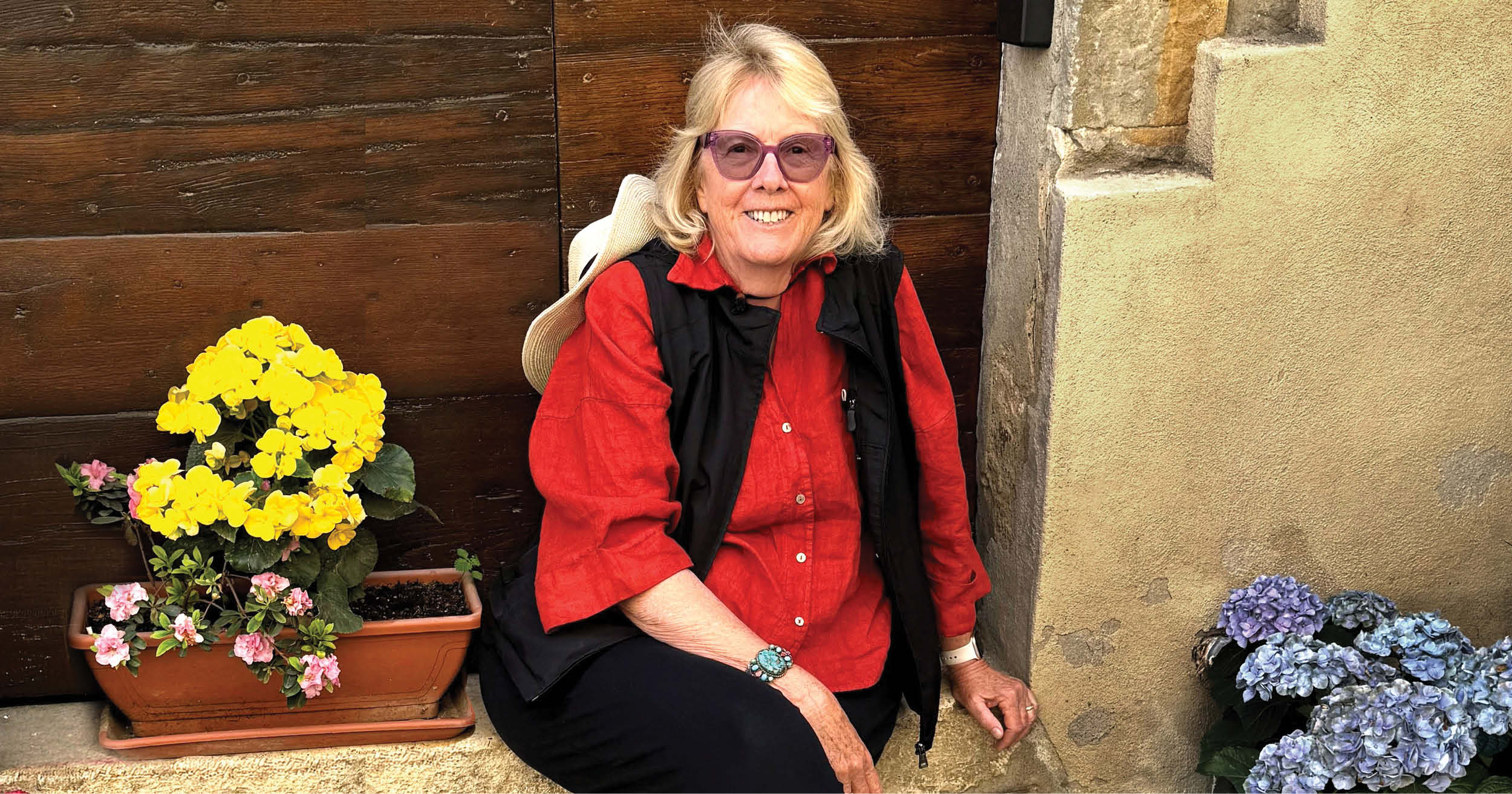
Photo: Dr. Carney in San Gimignano, Italy. She and her husband sold their practice in 2022 and enjoy traveling abroad.